
Helical Conveyor
Fast and Efficient Solids Handling
Helical Conveyors are widely used for material handling in wastewater treatment plants as well as in a variety of industrial applications.
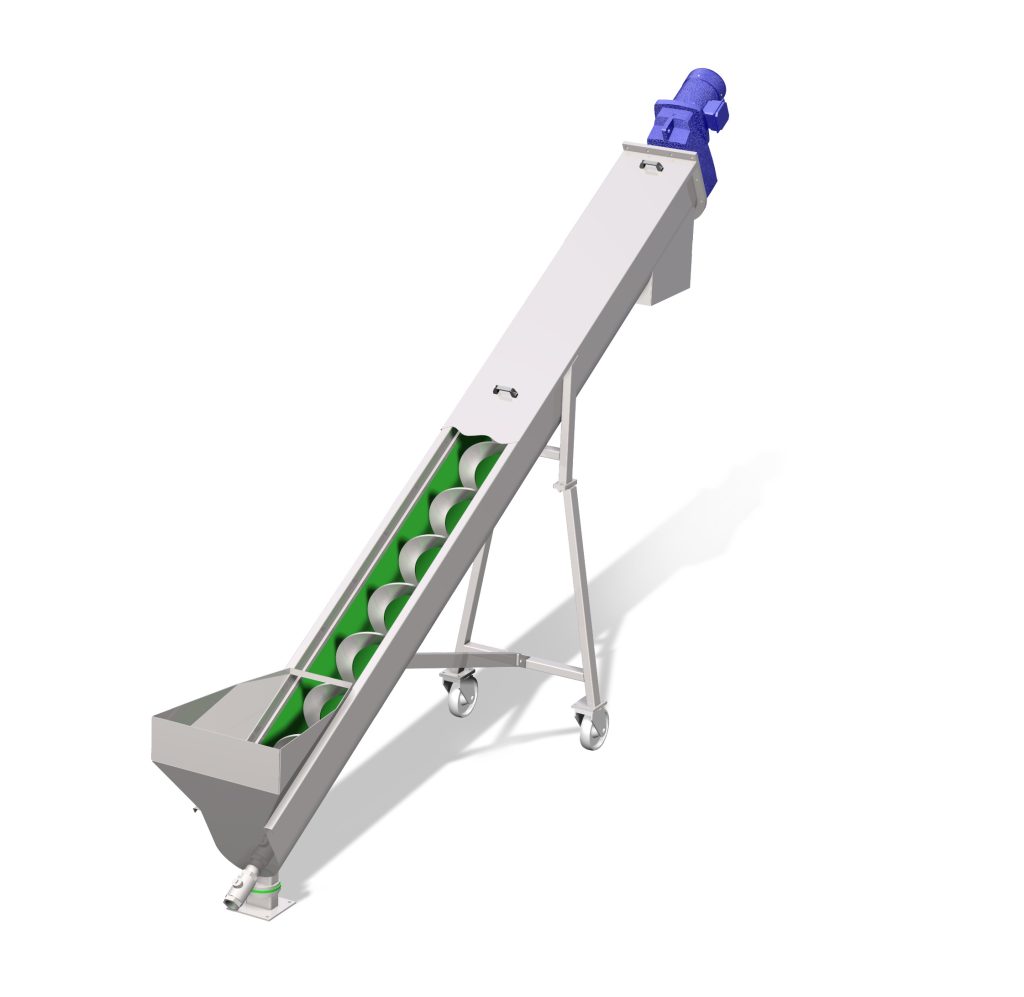
The system consists of a rotating screw housed within a trough lined with wear-resistant polyethylene. As the screw rotates, material fed into the inlet is conveyed to the discharge end and discharged through the outlet.
Depending on the application, Helical Conveyors can be manufactured in either inclined or horizontal configurations and are designed according to the required conveying distance. The screw diameter and pitch are selected based on the type of material to be conveyed and the required handling capacity. The screw is manufactured from either stainless steel or Hardox steel, depending on the application, and operates within a wear-resistant ultra high molecular weight polyethylene liner. The trough is manufactured entirely from stainless steel.
Because Helical Conveyors can operate at steeper inclinations than belt conveyors, they provide an efficient solution for conveying materials into containers, hoppers, and other elevated discharge points.
Screw Diameter
Up to Ø500 mm
Orientation
Inclined / Horizontal
Screw Material
ST52 / AISI304 / AISI316
Body Material
AISI304 / AISI316
Frequently Asked Questions
How is the liner replaced in a Helical Conveyor?
In Helical Conveyors, the screw is supported by UHMW Polyethylene wear liners. Thanks to the modular design, only the worn liner sections need to be replaced, eliminating the need to dismantle the entire system.
When should a Helical Conveyor be preferred over a Belt Conveyor?
Helical Conveyors can operate at steeper inclinations than belt conveyors. They are therefore well suited for applications where materials must be conveyed to higher elevations or discharged directly into containers. In addition, their enclosed trough design provides better control of odors and material spillage.
Does the screw configuration vary depending on the material?
The screw diameter, pitch, and material are selected according to the density, abrasiveness, and characteristics of the material to be conveyed. Depending on the application, the screw is typically manufactured from stainless steel or wear-resistant ST52 carbon steel. UHMW Polyethylene wear liners are used to support the screw, reducing friction and wear while minimizing maintenance requirements.