
Vacuum Sludge Scraper
Continuous Sludge Removal with Adjustable Natural Vacuum
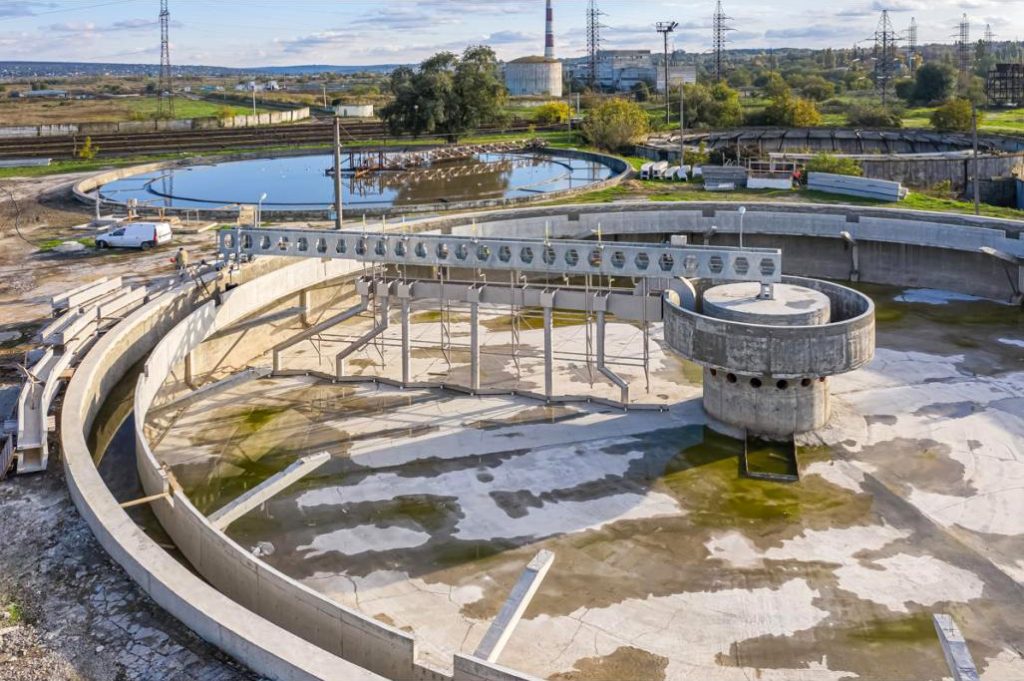
Vacuum Sludge Scrapers are used in sedimentation tanks of wastewater treatment plants to remove settled sludge efficiently from the system.
Utilizing the natural vacuum effect created by the system, the settled sludge is drawn from the bottom of the tank into a sludge collection trough suspended from the travelling bridge. From there, it flows by siphon action to the central sludge hopper. The telescopic support system allows the height of the sludge collection trough to be adjusted, varying the hydraulic head and enabling the sludge withdrawal rate to be precisely controlled.
Depending on the process requirements, Vacuum Sludge Scrapers can be manufactured in full-bridge, half-bridge, or tail-bridge configurations for tanks with diameters of up to 50 meters. The specially fabricated bridge structure is available in either stainless steel or hot-dip galvanized steel, while all components in contact with water are manufactured entirely from stainless steel.
Unlike conventional scraper systems that push sludge toward the center of the tank, Vacuum Sludge Scrapers remove sludge directly by suction without disturbing the sludge blanket. This makes them particularly suitable for applications with high sludge loading, ensuring efficient sludge removal while maintaining stable settling conditions.
Tank Diameter
Up to Ø50 m
Bridge Material
Galvanized / AISI304
Submerged Material
AISI304 / AISI316
Frequently Asked Questions
What is the difference between Vacuum Sludge Scrapers and Conventional Scraper Systems?
A Vacuum Sludge Scraper removes settled sludge by drawing it from the bottom of the sedimentation tank using the natural vacuum principle, rather than mechanically pushing it toward the center. In conventional scraper systems, the sludge is conveyed to the central hopper by scraper blades, whereas in Vacuum Sludge Scrapers, it is withdrawn directly through suction pipes. This method provides more controlled and uniform sludge removal while minimizing disturbance of the sludge blanket.
Does a Vacuum Sludge Scraper require a vacuum pump to operate continuously?
No, the vacuum pump is required only during the initial start-up to establish the siphon in the sludge collection system. Once the siphon has been established, the system continues to operate entirely by natural hydraulic flow without requiring the vacuum pump, resulting in no additional energy consumption for sludge collection.